Strategy
Build, Buy, or Outsource: GTM Framework for Pre-Seed Founders
A GTM strategy framework for pre-seed founders. Compare founder-led sales, hiring a Head of Growth, and outsourcing to an AI-driven growth partner. Includes decision matrix, budget benchmarks, and common mistakes.
Apr 16, 2025
10 minutes
Shaffy Röell
Build, Buy, or Outsource: A GTM Strategy Framework for Pre-Seed Founders
Pre-seed founders have three go-to-market options: founder-led sales, hiring a Head of Growth, or outsourcing to an AI-driven growth partner. The right choice depends on four variables: monthly GTM budget, product-market fit stage, ICP complexity, and team capacity. This framework helps you decide based on data, not instinct.
You just closed a €500K ($550K) round. Your product is live, the first conversations are happening, and now you face the decision that will shape your next 12 months: how do you set up your go-to-market? Do it yourself, hire a Head of Growth, or outsource to a partner?
Most founders make this call on instinct. That's a problem when your runway sits between 12 and 18 months and every month of misspent budget compounds. This framework replaces gut feeling with four measurable variables so you can make a GTM strategy decision you won't regret in six months.
Why Your GTM Strategy Determines Your Pre-Seed Runway
Go-to-market is the single largest cash drain after product development for pre-seed startups, and the wrong GTM choice burns through months of runway fastest. Pre-seed economics leave almost no margin for error. According to Carta's State of Pre-Seed report, the majority of pre-seed rounds in the US generate less than $1M in funding. Seed-stage teams are shrinking fast, too: Carta's compensation data shows the average startup closing a seed round in H1 2024 had just 5.3 employees, down from 6.9 in 2021.
A wrong hire costs you three to six months. That's the typical onboarding time for a Head of Growth who still needs to learn your market, build processes from scratch, and figure out your ideal customer profile (ICP). According to SignalFire's 2024 Talent Trends report, executive search timelines now average five to six months. A wrong agency wastes budget on generic outreach that misses your niche. And doing everything yourself? That's a direct path to founder burnout, right when you should be closing deals.
The good news: this isn't a binary choice. Each option works brilliantly in the right context. The key is matching your GTM approach to your current stage, budget, and complexity.
In short: A pre-seed GTM strategy comes down to three options: founder-led sales (free but time-intensive), hiring a Head of Growth (€5K–15K / $5.5K–16.5K per month but slow to ramp), or outsourcing to an AI-driven growth partner (€1.5K–5K / $1.6K–5.5K per month with results in weeks). The right choice depends on your budget, stage, ICP complexity, and team capacity.
The Three GTM Options for Pre-Seed Startups, Honestly Compared
Here's what each path actually looks like for a pre-seed startup with limited cash and a small team.
Option 1: DIY / Founder-Led Sales
Founder-led sales is the best GTM approach before product-market fit, when you need direct feedback from every prospect. It costs zero salary expense, but the opportunity cost is enormous.
If you have fewer than 10 customers and your ICP is still evolving, nobody can sell your product better than you. As Y Combinator advises in their startup library, founders should do things that don't scale early on. Jason Lemkin (SaaStr) and Pete Kazanjy (Founding Sales) have been making this case for years: founders must sell first, before anyone else does.
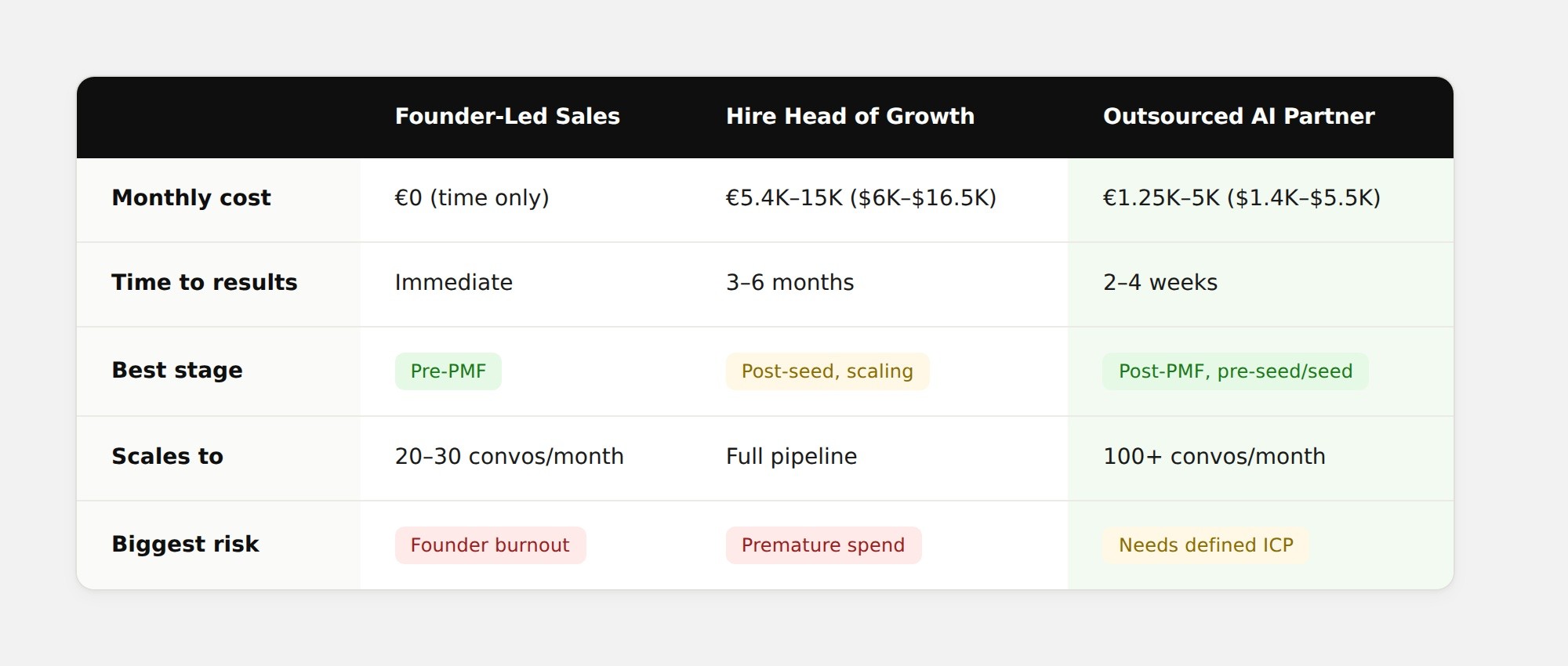
When does founder-led sales stop working? The moment you have product-market fit and need to scale beyond 20 to 30 conversations per month. Founders who keep doing all outreach themselves past this point sacrifice product development, fundraising, and strategic thinking: the three things only they can do.
Option 2: Hiring a Head of Growth (Full-Time or Fractional)
Hiring a full-time Head of Growth makes sense post-seed when you have validated GTM channels and a repeatable sales process. At pre-seed, it's usually too early and too expensive.
A full-time Head of Growth in Amsterdam commands between €65K and €181K per year ($72K–$200K) according to Glassdoor, roughly €5,400 to €15,000 per month before employer costs. Add three to six months of onboarding, and you're investing €30K to €90K ($33K–$100K) before seeing meaningful pipeline results.
Fractional hires reduce the monthly commitment to around €2,000 to €5,000, but they split attention across multiple clients and rarely embed deeply enough to build lasting systems. LinkedIn reported a 55% year-over-year increase in mentions of "fractional CTO" and "fractional CMO" roles in 2024, a sign that this model is going mainstream, especially pre-Series A.
When it works: post-seed, when you have validated GTM channels, a repeatable sales process, and enough pipeline to justify a dedicated operator.
When it breaks: at pre-seed. With most rounds generating less than $1M, committing €8K to €12K per month to a single hire is a disproportionate bet. Carta's data shows the average seed-stage consumer startup now has just 3.5 employees, down from 6.4 in 2022. Teams are leaner than ever, and a premature growth hire that doesn't perform means lost capital and time, the two things you can't recover.
Option 3: Outsourcing to an AI-Driven Growth Partner
An AI-driven growth partner automates go-to-market execution for startups, typically going live in two to four weeks at a fraction of the cost of a full-time hire. This option costs between €1,250 and €5,000 ($1,400–$5,500) per month, depending on scope.
What is an AI-driven growth partner? An AI-driven growth partner is a service provider that uses artificial intelligence to automate go-to-market execution for startups. This typically includes:
Target mapping and ranking – using AI to identify and score prospects based on firmographic data, technographic signals, and intent indicators such as funding rounds, job posts, and website visits.
Personalised multi-channel outreach – AI-generated email and LinkedIn messaging that adapts to each prospect's context, moving beyond generic templates to signal-based selling.
CRM automation – automatic logging of touches, replies, and deal stages so founders don't lose track of pipeline.
Automated pipeline management – combining data enrichment, multi-channel sequencing, and follow-up triggers into a single system.
Several companies now offer this model, including platforms like Instantly and Apollo (self-serve tools), and managed services like TechTower that handle end-to-end execution. This option has shifted dramatically since 2024. Modern AI-powered outbound tools use intent data, large language models for message generation, and automated A/B testing to continuously improve conversion rates.
When it works: when you have initial product-market fit (or are close), a defined ICP, and need to scale outbound without burning runway on a premature hire. Especially effective for B2B startups selling to a specific, well-defined audience.
When it breaks: if your product is still in concept stage and you haven't had a single customer conversation. No outreach system, however sophisticated, compensates for a product nobody wants.
Quick Comparison: Founder-Led vs. Hiring vs. Outsourcing
The GTM Decision Matrix: Four Variables That Actually Matter
The right GTM strategy for a pre-seed startup depends on four measurable variables: monthly budget, product-market fit stage, ICP complexity, and internal team capacity. Stop asking "what feels right" and start scoring each one.
Variable 1: Monthly GTM budget
Under €3K ($3.3K): founder-led is your only realistic option. Between €3K and €8K ($3.3K–$8.8K): an outsourced partner gives you the most leverage per euro/dollar. Above €8K ($8.8K): hiring becomes viable, but only if the other three variables also align.
Variable 2: Stage – pre-PMF, post-PMF, or scaling
Pre-PMF means you need direct customer contact; that's founder-led territory. Post-PMF with a clear ICP is where outsourced systems deliver the best ROI. Scaling with proven channels is when a full-time hire earns its cost.
Variable 3: ICP complexity
Selling to a single persona at one type of company? An automated AI outbound system handles that well. Multi-stakeholder enterprise deals with six-month cycles? You need a human operator who can navigate complex buying committees.
Variable 4: Internal capacity
Solo founder or a two-person team? You simply don't have bandwidth for both product and GTM execution. Outsourcing becomes a force multiplier. The rise of solo founders – 35% of new startups in 2024, up from 17% in 2015 – makes this variable more relevant than ever. A team of four with some commercial experience can sustain founder-led sales longer.
Common Mistakes That Burn Pre-Seed Runway
The most expensive GTM mistakes at pre-seed are hiring too early, choosing a generic agency, and holding on to founder-led sales too long.
Hiring a VP Sales before you've sold anything yourself. You need to understand objections, pricing sensitivity, and deal cycles first-hand. Nobody can design a sales process for a product they didn't help sell.
Choosing a generic agency that doesn't know your market. A B2C marketing agency running your B2B SaaS outbound is a recipe for wasted spend. Look for partners with specific experience in your vertical and buyer type. Ask for case studies, not pitch decks.
Doing everything yourself until you break. Founder-led sales is essential early on, but holding on to it past product-market fit is a trap. Carta reports that sales accounted for nearly 20% of all new startup hires in 2024, up from 14.8% in 2020, confirming that even lean startups are prioritising commercial capacity. Startups that systematise their outbound earlier free up founder time for the three things that actually compound: product improvements, hiring, and fundraising.
How Should a Pre-Seed Startup Choose a GTM Partner?
The best GTM partners for pre-seed startups deliver pipeline within weeks, offer full data ownership, are honest about fit, and price their services in line with early-stage budgets. Here's what to evaluate:
Speed to results. If a partner needs three months of "strategy workshops" before sending a single message, that's a red flag. At pre-seed, you need pipeline within weeks, not quarters. Look for partners that can go live in two to four weeks with a working system.
Transparency on what you're getting. Ask specifically: will you own the data, the contacts, and the CRM setup if you stop working together? Many agencies keep proprietary systems that lock you in.
Honest about fit. A good partner will tell you when you're not ready yet. If they'll take your money regardless of whether you have product-market fit, that tells you everything about their incentive structure.
Pricing alignment with your stage. A pre-seed startup spending €3K to €5K ($3.3K–$5.5K) per month on outsourced GTM should expect a fully managed system, not a retainer with vague deliverables. Compare the monthly cost against the alternative: a full-time growth hire at €8K to €15K per month that needs three to six months to ramp.
How Much Should a Pre-Seed Startup Spend on GTM?
Most pre-seed startups with initial traction should allocate between €3K and €8K ($3.3K–$8.8K) per month to go-to-market. Below €3K, founder-led sales is the only realistic path. Above €8K, a dedicated hire becomes viable, but only post-seed when channels are validated. The sweet spot for outsourced GTM, including AI-powered outbound, CRM automation, and target mapping, falls in the €3K to €5K range.
What an Outsourced AI Growth Engine Actually Delivers
An outsourced AI growth engine replaces the three to six months of setup work a Head of Growth would need, delivering a working outbound system within weeks at roughly a quarter of the cost. For pre-seed founders, that difference can mean making it to the next funding round versus running out of runway.
In practice, a managed AI growth engine at this stage typically includes: target mapping and ranking of ideal prospects, personalised email and LinkedIn outreach sequences, CRM automation for pipeline tracking, and signal-based triggers that identify high-intent prospects based on funding rounds, hiring activity, and technology adoption signals.
That's not replacing a Head of Growth. It's replacing the setup phase so that when you do hire, they inherit a working system with data, proven messaging, and active pipeline.
Where this model doesn't fit: if you're pre-product with no customer conversations yet, you need founder-led discovery first. Starting outreach without a validated proposition wastes everyone's time.
Disclosure: TechTower offers a managed AI growth engine built specifically for pre-seed and seed-stage B2B startups. For €3K per month, you get the full system described above: target mapping, personalised outreach, CRM automation, and signal tracking. Several companies offer similar services – the framework in this article applies regardless of which partner you evaluate.
Frequently Asked Questions: GTM Strategy for Pre-Seed Startups
What is the best GTM strategy for a pre-seed startup?
The best GTM strategy depends on four variables: monthly budget, product-market fit stage, ICP complexity, and team capacity. Before product-market fit, founder-led sales is the best approach. After PMF with a budget between €3K and €8K ($3.3K–$8.8K) per month, outsourcing to an AI-driven growth partner typically provides the best ratio of speed, cost, and results. Hiring a full-time Head of Growth makes sense post-seed when channels are validated and budget exceeds €8K per month.
How much should a pre-seed startup spend on go-to-market?
Most pre-seed startups with initial traction should allocate between €3K and €8K ($3.3K–$8.8K) per month to GTM. Below €3K, founder-led sales is the only realistic option. The sweet spot for outsourced AI-powered GTM falls in the €3K to €5K range, covering outbound outreach, CRM automation, and target mapping.
When should a founder stop doing sales themselves?
Founders should stop doing all outreach themselves once they have product-market fit and need to scale beyond 20 to 30 prospect conversations per month. At that point, continuing to handle all sales sacrifices product development, fundraising, and strategic thinking – the three activities only a founder can do. This is the right moment to either outsource GTM execution or hire a dedicated growth operator.
What is an AI-driven growth partner?
An AI-driven growth partner is a service provider that uses artificial intelligence to automate go-to-market execution for startups. Services typically include AI-powered target identification and scoring, personalised multi-channel outreach (email and LinkedIn), CRM automation, and signal-based selling triggered by intent data like funding rounds, job posts, and website visits. Companies in this space include platforms like Instantly and Apollo (self-serve) and managed services like TechTower (end-to-end execution).
Should a pre-seed startup hire a Head of Growth or outsource?
At pre-seed, outsourcing typically offers a better risk-adjusted return. A full-time Head of Growth costs €5.4K to €15K per month and needs three to six months to ramp, representing a €30K–€90K investment before results. An outsourced AI growth partner costs €1.25K to €5K per month and can go live in two to four weeks. Hiring makes more sense post-seed when you have validated channels, a repeatable process, and budget to support a dedicated operator.
What is signal-based selling for startups?
Signal-based selling uses real-time data triggers – such as a prospect's company raising funding, posting relevant job openings, or visiting your website – to time outreach for maximum relevance. AI-driven growth partners use these signals to prioritise prospects and personalise messaging, resulting in higher response rates compared to generic cold outreach.
Pick Your GTM Strategy Based on Data, Not Instinct
The right GTM strategy for a pre-seed startup depends on four concrete variables: budget, stage, ICP complexity, and team capacity. It isn't about what's trendy or what worked for a Series B company.
For most pre-seed founders with initial traction and a monthly GTM budget between €3K and €8K, outsourcing to an AI-driven growth partner offers the best ratio of speed, cost, and quality. It lets you scale outbound systematically while keeping your focus where it belongs: on product, customers, and your next raise.
Summary: GTM strategy for pre-seed startups. Pre-seed founders choosing a go-to-market strategy should evaluate four variables: monthly budget, product-market fit stage, ICP complexity, and team capacity. Founder-led sales is best pre-PMF. Hiring a Head of Growth (€8K+/month) makes sense post-seed with validated channels. For most pre-seed startups with a €3K to €8K monthly budget, outsourcing to an AI-driven growth partner provides the fastest path to pipeline at the lowest cost, going live in two to four weeks instead of three to six months.
Want to find out which option fits your situation? Request a free target map and discover in two weeks what an AI-driven growth engine can do for your pipeline.
Sources
Carta – State of Pre-Seed Q3 2025: carta.com/data/state-of-pre-seed-q3-2025
Carta – Startup Compensation H1 2024: carta.com/data/startup-compensation-h1-2024
Carta – Startup Headcounts 2024: carta.com/data/startup-headcounts-2024
Carta – Startup Compensation H2 2024: carta.com/data/startup-compensation-h2-2024
Glassdoor – Head of Growth Salaries, Amsterdam: glassdoor.com
Y Combinator – Essential Startup Advice: ycombinator.com/library/4D-yc-s-essential-startup-advice
Jason Lemkin – SaaStr: saastr.com
Pete Kazanjy – Founding Sales: foundingsales.com
SignalFire / Centum Search – 2025 Startup Hiring Trends: centumsearch.com/2025-startup-hiring-trends
Development Corporate – State of Seed 2025, Solo Founder Data: developmentcorporate.com/startups/state-of-seed-2025-saas-founders
TechTower – Signal-Based Selling: techtower.ai/blog/signal-based-selling